Real-Time Payment Intelligence
Securing banks against AI-assisted fraud before money moves.

Core Capabilities
Numbers that speak for themselves
BoltShield currently manages structured and unstructured data, including billions of records.
<0ms
<0ms
p99 decision
edge → verdict
0.0B+
0.0B+
Detected E
single-paisa slice
0.0%
0.0%
Rails covered
and counting
Rail Fabric
One fabric across every rail
Seamlessly unify UPI, IMPS, AEPS, NEFT and SWIFT into a single intelligent layer powering real-time, secure and scalable transactions across India.
UPI
Real-time P2P/P2M
14.4B txn/mo
IMPS
24×7 interbank
560M txn/mok
AEPS
210M/mo
210M txn/mo
NEFT
Bulk batched
420M txn/mo
SWIFT / RTGS
High-value cross-border
₹1.6 quadrillion/yr
Per-Rail Defenses
Each rail gets a purpose-built model, not a one-size-fits-all rule engine.
Models trained on the failure modes specific to each payment system, deployed as composable scorers in a unified runtime.


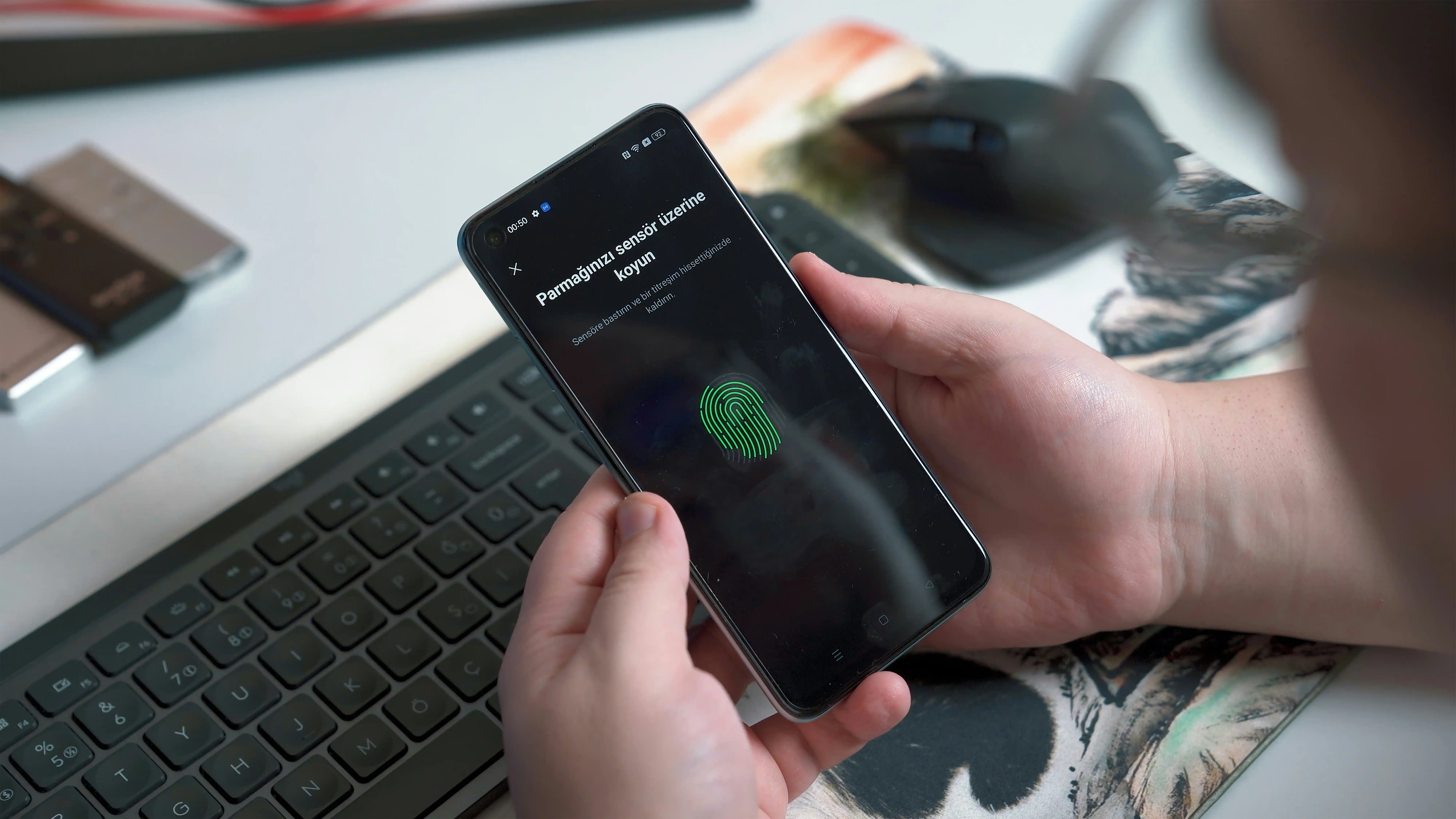


Graph engine
A payments-native knowledge graph, not a tabular feature store.
Every account, device, VPA, IP, beneficiary, and merchant is a node. Every transaction, login, KYC submission, and dispute is a typed edge. Traversal happens in-memory with custom Rust kernels — billions of edges per query, single-digit-millisecond responses.
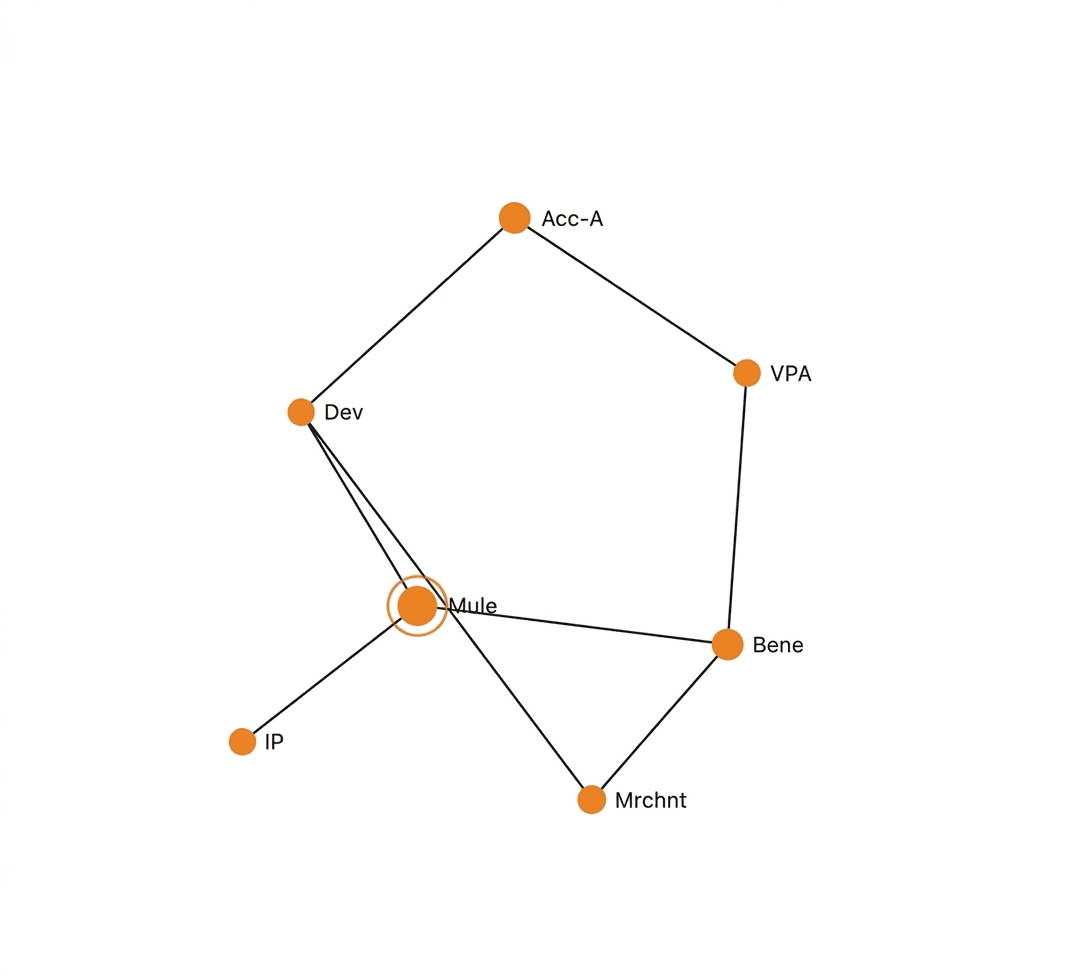
Native edge types
47 financial + behavioral
Hop depth at p99
6 hops in <12 ms
Streaming ingest
1.4 B edges / day
Backfill window
730-day rolling
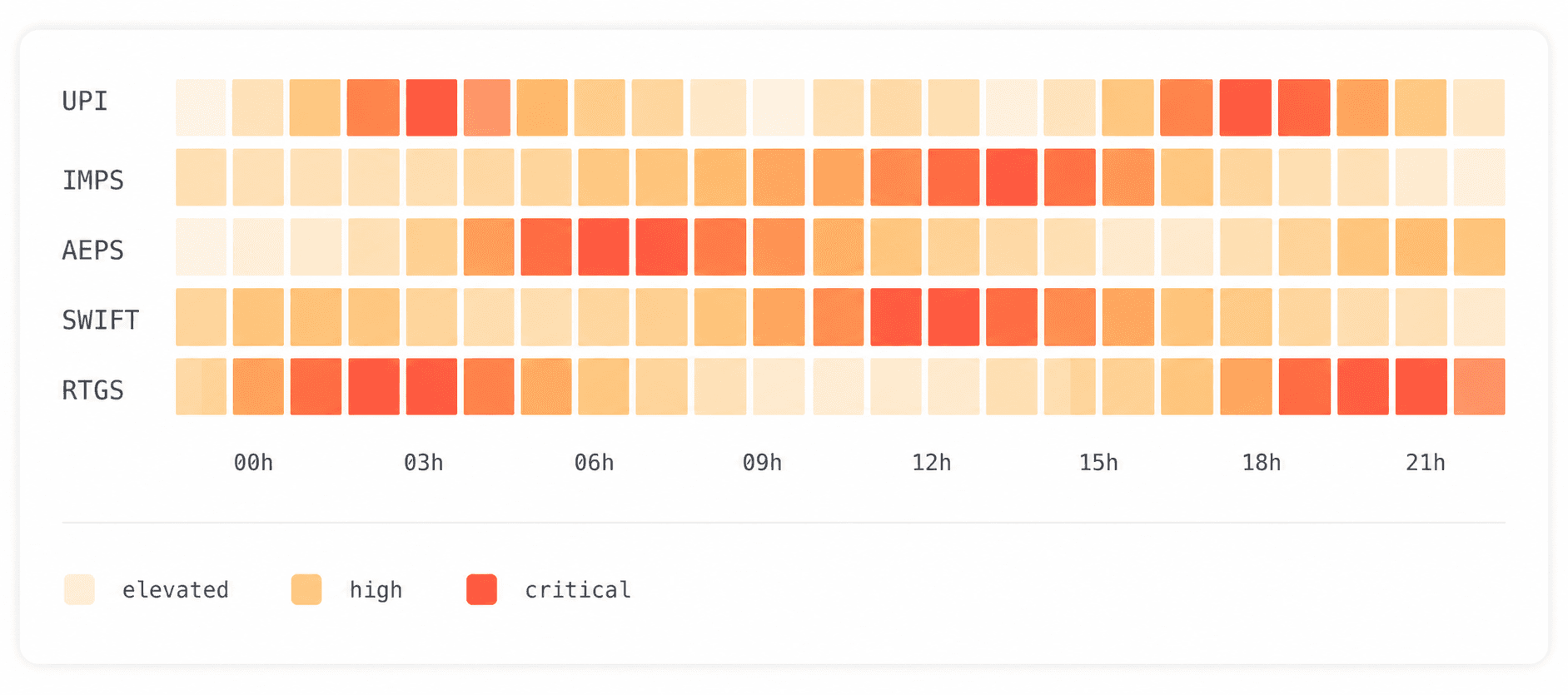
Anomaly surfaces
See attack waves form across rails, hours before they cross detection thresholds.
Continuous unsupervised baselines per rail, region, and merchant-category. Coordinated bursts that any single rule would miss light up as red bands across the heatmap.
Decision pipeline
From wire-on to action in under 80 milliseconds.
Five deterministic stages, all observable, all reversible, all explainable to your auditor.
How it works
A six-step streaming flow from rail tap to recall.
No batch jobs, no overnight extracts. Every step is online, observable, and tested against replayed production traffic before it touches a live transaction.
For Banks
Six outcomes that map to how your fraud, risk, and compliance leaders are measured.
BoltShield isn't a model in a notebook — it's an operating system for fraud loss reduction with KPIs your CRO, COO, and CCO already report on.
Identify
Surface mule rings, deepfake KYC, and prompt-engineered social-engineering attempts the moment they touch the rail — not after reconciliation.
Quantify
Per-rail loss exposure, attacker-cohort sizing, and probable monthly leakage with confidence intervals — the language your CFO and board want.
Prevent
Inline block, step-up authentication, transaction throttling, and beneficiary cool-downs applied at switch speed without breaking good customer flows.
Comply
RBI Master Direction on Digital Payment Security, FIU-IND STR/CTR formats, PMLA evidentiary trail, and DPDP-aligned data handling — generated, not bolted on.
Recover
Automated recall orchestration across UPI Chargeback, IMPS dispute, and SWIFT pacs.004 — with beneficiary-bank workflow tracking through to credit-back.
Defend
Adversarial red-team replay. We continuously simulate the latest LLM-assisted attacks against your live policy and report drift before fraudsters find it.
Preventive Playbook
Six rules live on day one - tuned to your portfolio in week one.
Customizable via decision DSL
How BoltShield helps
One decision fabric. Three operator profiles. Measurable loss reduction for each.
Banks, fintechs, and payment infrastructure operators face different fraud economics — but the underlying graph of money, identity, and intent is the same. BoltShield exposes that graph as actionable decisioning, shaped to the metrics each operator is measured on.
For banks: shrink fraud loss without slowing the branch, app, or BC network.
30–55%
rail fraud loss reduction in 2 quarters
<80ms
p99 inline decision latency
6 weeks
go-live on first rail
−40%
analyst hours per confirmed case
WHERE THE PAIN SHOWS UP → HOW BoltShield ANSWERS
One decision plane across UPI, IMPS, AEPS, NEFT, RTGS, SWIFT
Retire 4–6 rail-specific rules engines and the integration tax they impose on every product launch.
Inline action, not after-the-fact alerting
Block, step-up, or cool-down at the switch in <80ms — your false-positive rate falls because the model sees the full graph, not a single transaction.
Regulator-grade explainability
Reason codes, feature contributions, and policy lineage attached to every decision — passes RBI SAR and FIU-IND audit on first read.
VPC-resident, DPDP-aligned deployment
Runs inside your data centre or our Mumbai/Hyderabad zones; no cross-border exfiltration, no shadow data lake.
WHERE THE PAIN SHOWS UP → HOW BoltShield ANSWERS
API-first decision endpoints
Single /decide call returns score, reason codes, and recommended action — drop into the payment, KYC, or login flow without re-architecting.
Policy DSL owned by risk, not engineering
Risk analysts ship rule changes through a typed DSL with shadow-mode replay — no release-train coupling.
Sponsor-bank visibility built-in
Read-only evidence portal for your sponsor bank's compliance team; reduces back-and-forth that kills product velocity.
Outcome-linked commercials
Pay a share of leakage prevented, not a per-transaction tax that scales with your growth.
For fintechs: ship growth features without inheriting the next regulator advisory.
<2 weeks
API integration to first decision
−60%
synthetic-onboarding success rate
3.5×
fraud-team throughput per analyst
0
per-transaction fees on clean traffic
For payment infrastructure: protect the rail itself — every member benefits.
Switch-class
throughput with <80ms p99
Federated
intel without PII movement
100%
of decisions independently replayable
Member ↑
trust as a network differentiator
WHERE THE PAIN SHOWS UP → HOW BoltShield ANSWERS
Network-grade scale
Engineered for switch-class throughput with predictable tail latency under burst and brownout.
Privacy-preserving federation
Members contribute encrypted graph signals; raw PII never leaves their VPC, intelligence still propagates.
Member-facing intelligence feeds
Push enriched risk signals back to issuers and acquirers as a value-add that strengthens the network.
Rail-level attestation
Quarterly fraud-posture reports your regulator and member banks can both rely on.
Preventive Playbook
Six rules live on day one — tuned to your portfolio in week one.
Customizable via decision DSL
Loss curve, bent down
Measured rail-by-rail leakage reduction inside two quarters — baselined against your own last four quarters, not a vendor benchmark.
Latency budget, respected
<80ms p99 inline decisioning means risk never becomes the reason a good customer abandons a payment.
Regulator, on your side
Every decision ships audit-ready: reason codes, feature contributions, deterministic replay, DPDP-aligned data handling.
Operating model, upgraded
Analysts work cases enriched with full graph context — investigation time per confirmed case drops by 40%+.
Why BoltShield
The first fraud platform engineered for India's rails — and for attackers who use AI.
Most India fraud-tech is a card-era rules engine with a UPI adapter. BoltShield is graph-native, AI-adversarial, and built around the way Indian payments actually move money.
| CAPABILITY | ✕ TYPICAL INDIA FRAUD-TECH | ✓ BoltShield |
|---|---|---|
| Detection substrate | Tabular features + rules | Native graph with 47 edge types |
| Decision latency | 200–600 ms (often async) | <80 ms p99, inline |
| Rail coverage | Mostly cards + UPI | UPI, IMPS, AEPS, NEFT, RTGS, SWIFT — one fabric |
| Model refresh | Quarterly batch retrain | Nightly retrain + shadow replay |
| AI-attack readiness | Static rules, brittle to LLM tactics | Adversarial red-team built-in |
| Explainability | Black-box scores | Per-decision reason codes for RBI/FIU |
| Deployment | Months of ETL & sandbox | Drop-in connectors, 6-week production cutover |
| Pricing model | Per-transaction tax on growth | Outcome-linked: paid against leakage prevented |
Graph-native, not graph-bolted
Built from the ground up on a payments knowledge graph — we don’t shoehorn graph queries onto a Postgres warehouse.
Built for the AI-attack era
Adversarial pipelines simulate deepfake KYC, voice-cloned callbacks, and LLM-scripted social engineering against your live policy weekly.
Explainable to your regulator
Every decision ships with reason codes, feature contributions, and a deterministic replay — passes RBI and FIU-IND audit on first read.
India-resident by default
Data plane runs inside your VPC or our Mumbai/Hyderabad zones. DDP-aligned, RBI data-localisation compliant.
Production in six weeks
Reference connectors for Finacle, FLEXCUBE, BaNCS, TCS, Infosys, and the NPCI switch.
Built with Indian banks
Designed alongside fraud and risk leaders from public-sector, private, and small-finance banks.
THE LEAKAGE BET
We get paid only when we cut your fraud losses.
If we don't, you don't pay.
Sign with us on an outcome-linked contract: a measured baseline of your last four quarters of rail-by-rail fraud losses, a 90-day deployment, and a 12-month measurement window. BoltShield’s fee is a fixed share of verified leakage prevented — audited by your internal team and a Big-Four assurance partner. Zero prevention, zero invoice.
BASELINE
Your last 4 quarters of measured fraud loss
WINDOW
12 months from go-live, rail-by-rail
FEE
Share of verified leakage prevented — never of GMV

Delivering IT solutions that enable you to work smarter
Maximizing Your Potential with Tailored Solutions